Bringing a business idea to life often requires SMEs or startups to hire an experienced team to deliver their projects successfully. But they may face a significant problem related to the tech talent shortage. For instance, the ManpowerGroup survey shows that 72% of employers struggle to find the qualified staff they need.
Fortunately, opting for IT outstaffing services can help organizations augment their existing team with the required expertise. Below, we will analyze the basics of smart outstaffing and its most critical advantages, and we’ll also provide a helpful guide on choosing a reliable outstaffing agency.

IT outstaffing services refer to a remote hiring model in which an outstaffing company provides a dedicated team or individual specialists to the customer for a software development project. These specialists work only on the client’s project for the contracted period, while the outstaffing vendor remains their official employer. Although the customer has complete control over the outstaff team, it does not have to deal with any of the operational issues that come with employment.
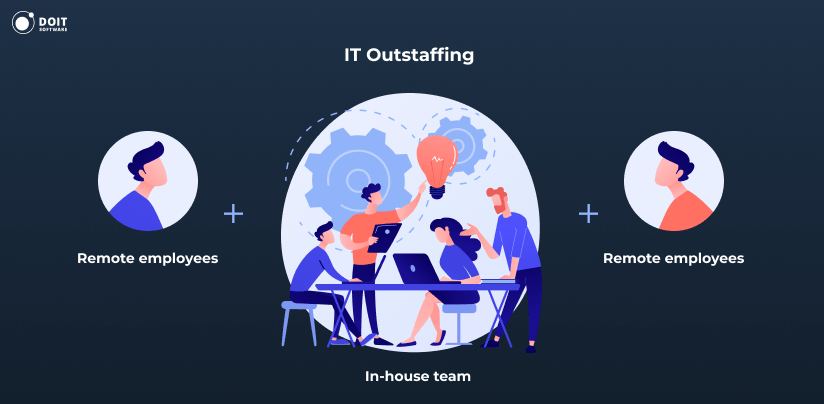
The most common situations when businesses start working with an IT outstaffing company are the following:
There are situations in which outstaffing tends to be especially useful for a growing tech team.
The first is a launch deadline that your current engineering capacity simply cannot meet. The roadmap and the specifications might be ready, but spending another quarter on hiring would put the launch date at risk. Outstaffing can bring qualified developers into the project in a matter of days, and these developers will often have built similar features for other clients before.
The second is a specialist role that is too narrow to justify a permanent hire. For example, a mobile-app specialist or a workflow-automation expert might be exactly what the team needs for one specific project, but the team may not need that role over the longer term. Hiring full-time for a six-month build can leave you with an awkward conversation when the work eventually ends.
There is also one situation in which outstaffing is not the right approach. When you are hiring for a founding-engineer role, or for someone who will run an entire function over several years, you need a person whose career path can grow along with the company. That person typically belongs on the payroll, often with equity. Outstaffing fits capacity gaps and specialist roles well, but founding seats really do call for a different kind of hire.
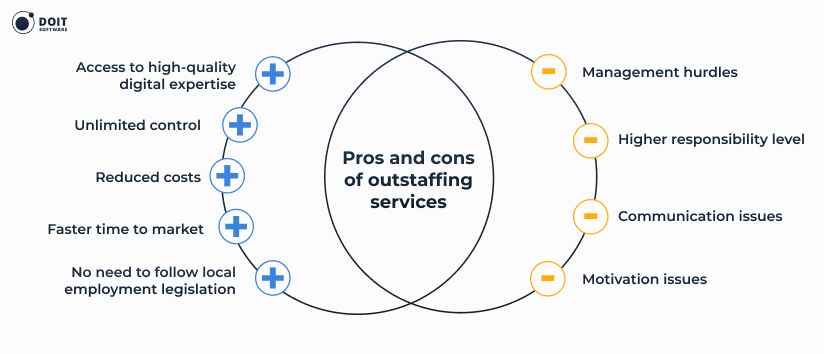
Using IT outstaffing services provides businesses with many significant advantages and thus helps them stay competitive, scale faster, and increase revenue. Here, we will analyze the top-five benefits of outstaffing that make it a perfect option to choose.
Organizations from various industry niches always need experienced IT specialists with the appropriate knowledge in their field. How to prevent fraud in the supply chain, store patients’ data, or build an app that analyzes insurance-related data and comes up with a prediction? All these cases can be covered by experienced software developers and the appropriate experts.
And since finding and hiring these specialists in-house is often challenging, IT outstaffing services can really come in handy. A reliable remote staffing agency always has professionals with vast experience in solving common industry challenges.
Thus, they understand the specifics of the customers’ business and know how to address and prevent potential issues in fintech, healthcare, eCommerce, etc. With the use of smart outstaffing, organizations ensure that they get first-class services facilitating best practices in their niches.
Apart from sharing expertise, specialists provided by outstaffing companies continuously upgrade their skills. That helps them to keep up with the hottest industry trends and innovations and know how to implement new technologies in practice. Ultimately, they can assist clients’ in-house teams in choosing the most efficient tech stack to create digital products.
The good news for businesses considering IT outstaffing services is that they get complete control over the hired specialists, the development process, and its outcomes. This allows them to manage the hired staff directly and much more effectively. Today there are plenty of collaboration tools ensuring faster and more productive project management.
In addition, an IT outstaffing model can assist you in tracking the work quality, scaling up and down your teams if needed, and improving the talent management policies inside your company. Meanwhile, extending your in-house teams with staff augmentation services not only helps fill the gap in IT expertise, but also enhances the skills of your in-house team. All you need to do is establish strong cooperation between in-house teams and the remote staffing talent.
Speeding up hiring processes is among the top-three recruitment-related priorities for many companies. That is because they aim to accelerate their solutions’ time to market.
Partnering with an IT outstaffing company is particularly advantageous when your in-house team has problems meeting the current project deadlines. Or your business may need to launch new projects and handle other critical IT tasks simultaneously.
With IT outstaffing services, organizations obtain faster time to market for their products. They do not need to search for experienced tech specialists who can deliver the project successfully. Since an outstaffing agency is responsible for offering top developers to fit specific project requirements, clients have more time to deal with their core operations.
When hiring an in-house IT team, each business must follow the employment regulations in its own country. But such legal rules may be stringent or require companies to pay additional expenses, which is often challenging, time-consuming, and costly. For instance, companies must deal with the workers’ paid leaves, retirement benefits, dismissal rules, etc.
However, when partnering with a remote staffing agency, you will obtain a simple team hiring process and also proper dismissal conditions. After all, IT staffing agencies cover all the necessary employment requirements in their respective countries.
Numerous companies undoubtedly opt for IT outstaffing services because of the chance to reduce their resourcing and project costs. What makes this possible?

Although software outsourcing and outstaffing are widely used models, both have their shortcomings. For example, the critical disadvantages of using IT outstaffing services are the following:
When comparing outsourcing vs. outstaffing, the key difference is that the first provides the vendor with the authority to do specific tasks or business processes due to the contract. In the second case, you hire developers through the vendor and run the delivery yourself, while the vendor takes care of the legal-employer side.
Below, we have briefly mentioned some more critical differences.
Tech expertise needed on your side
Lower. Creating requirements is all you need to do. It can be done together with the development team during the discovery phase.
Higher. You set the technical direction and manage the developers' day-to-day work.
Cost
Usually higher because the vendor covers project management, QA, design, and delivery overhead on top of developer time.
Cheaper since the client performs many project-related tasks on his own and pays only for developer time.
Responsibility
Vendor owns delivery and the agreed outcome.
Client owns delivery; vendor owns employment and admin.
Management
The vendor’s project manager manages the team.
The customer manages outstaff employees personally or by an internal project manager.
Speed to start
Slower, outsourcing requires time to create specifications and build the team.
Faster, but the client’s project specifications should be prepared in advance.
The cost of IT outstaffing depends on developer seniority and on the region the developers come from. For vetted mid-level and senior developers, rates from Eastern European and Latin American vendors typically range from $35 to $80 per hour. For comparison, the equivalent total cost of an in-house developer in the US or Western Europe usually works out to between $80 and $150 per hour. The vendor’s rate normally includes payroll, employer taxes, equipment, paid leave, and HR admin.
The hourly rate alone does not tell the whole story. The real comparison is between the total cost of each option. For example, an in-house senior engineer in a US tech hub with a $150,000 salary actually costs the company closer to $200,000 per year once you include benefits, employer taxes, office overhead, equipment, and recruiter fees. A vetted Eastern European or Latin American senior developer at $65 per hour works out to roughly $135,000 per year for a full 40-hour week, and the vendor covers every one of those overhead categories.
There are a few things worth checking when you compare rate quotes from different IT outstaffing vendors:
DOIT typically places vetted mid-level and senior developers from Eastern Europe and Latin America in the $35 to $70 per hour range, with payroll, contracts, legal, HR, and equipment all included in the rate. The exact rate depends on the technologies the role requires and on the seniority of the developer.
Whenever the total cost of an in-house hire is higher than the outstaffing rate for the same role and seniority level, the outstaffing model effectively pays for itself.
When browsing the Internet, you will see numerous companies providing IT outstaffing services. They can help your organization adopt this model to your business processes and obtain the mentioned benefits. But how to select the right partner to reduce the potential outstaffing drawbacks? Below, we have created a checklist to assist you in your search.
If you prefer outstaffing in Eastern Europe and partnering with DOIT Software, the process will include the following stages:
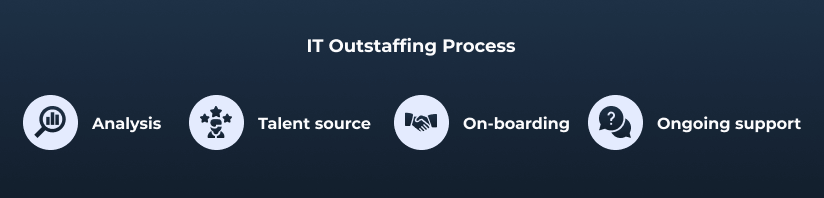
So you have decided to use IT outstaffing services. But where should you find a reliable, experienced partner to meet your project needs? Here are some helpful resources:
It is a good idea to cross-reference at least two of these sources before requesting CVs. Directory listings, public reviews, recent posts, and a vendor’s own thought leadership together give you a clearer picture than any one source on its own.
When it comes to IT outstaffing, Eastern Europe is among the most popular destinations.
Contact DOIT Software and hire high-quality tech specialists for your project.
When evaluating your potential IT outstaffing vendor, you should consider the following critical factors to ensure that they will meet your business requirements.
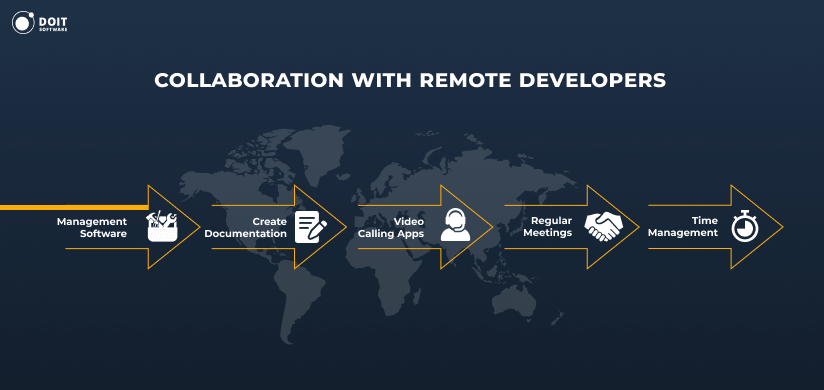
Managing remote developers undoubtedly differs from managing your in-house team. Thus, when using IT outstaffing services, you must ensure effective cooperation with augmented personnel. Here we have briefly described a few trips and tricks on how to do that.
When deciding whether to outsource vs. outstaff, many companies prefer the second option. All because IT outstaffing services provide excellent results due to full team dedication to projects. After all, more and more businesses have started hiring remote teams to deliver their projects. So, if you do not want to worry about where to hire high-quality developers and what taxes you should pay for them, opt for IT outstaffing services.
Therefore, get in touch with DOIT Software to augment your team with additional expertise. With staff augmentation provided by DOIT Software company, you will get significant benefits:
Outstaffing is a remote staffing model where the IT vendor provides the customer with additional resources, one or a few developers, or even a dedicated team. The vendor handles the hiring and remains the legal employer, while the developer works exclusively on your project. The client manages the day-to-day work. The vendor handles contracts, payroll, equipment, and HR admin.
IT outsourcing means delegating business tasks or processes to external software agencies. In this case, communication is limited, you get weekly/monthly reports and project demos from a project manager. Meanwhile, IT outstaffing services provide clients with complete control over the team, although it is officially registered as a vendor’s staff.
The most critical advantages of IT outstaffing services are the access to a global talent pool, full control over the team, faster time to market, cost reduction, and the absence of legal and administrative issues.
There are three main signals that point toward outstaffing. The first is a defined-scope project that will last between 3 and 12 months. The second is a skill that the team needs for the current build but will not need over the longer term. The third is capacity that the team needs within a few weeks, while a typical in-house hire would take much longer to bring in.