The role of Human Resources has been established many years ago and continues to gain traction in the business environment. Especially in the IT field, recruiting is a crucial part of a company’s success.
A professional technical recruiter needs to understand the most prominent technologies as well as their use in the software development process. Most tech recruiters are not coders themselves, so they are often asked to provide certificates and other achievements that show that they have first-hand expertise in the world of technology. On top of that, they should be qualified to assess a candidate’s soft skills and overall fit in the company.
Most teams end up hiring a technical recruiter either too early or too late. And the right call depends on the engineering stack, the hiring volume, and the cost of the next bad engineering hire. But how do you go about hiring a technical recruiter who has both technical expertise and excellent interpersonal skills? What are the main challenges of technical recruiting? Keep reading to learn helpful tips for attracting the right technical recruiter for your team.

A technical recruiter is a specialist who sources, screens, hires, and closes candidates for engineering and product roles. Unlike a generalist recruiter, a technical recruiter has enough literacy with the languages, tools, frameworks, and workflows developers use day to day to read a candidate’s GitHub profile (the public site where developers share code), parse a CTO’s job description, push back when a candidate’s experience does not match the role, and run a competent technical screen.
Most technical recruiters are not coders themselves, so they earn the trust of engineering managers through comfort with the technology stack and a habit of aligning closely with the hiring manager on what a strong candidate actually looks like before any time gets wasted.
A professional technical recruiter cuts hiring expenses, accelerates the process, fills positions with candidates who actually match the brief, and lowers the bad-hire risk. The harder question, and the one most of this article addresses, is what makes a technical recruiter best at the job, and what qualifications and skills they should have when you are paying for one.
A technical recruiter differs from a general recruiter in two ways that matter most: comfort with the technology stack and the places they look for candidates. A general recruiter can run a competent process for marketing, sales, ops, or finance roles, but engineering hiring is a different game. A technical recruiter can read a developer’s GitHub, parse the difference between a Node and a Go backend role, source candidates from places a generalist has never opened, and brief a CTO on a candidate without translation.
Role types
Sales, marketing, ops, finance, HR
Engineering, data, DevOps, product, design
Sourcing channels
LinkedIn, job boards, employee referrals, ATS rediscovery
LinkedIn, GitHub, Stack Overflow, niche communities, AI sourcing tools
Screening depth
Behavioral interview, work history check
Technical screen, code review, take-home checks, GitHub portfolio review
Tech-stack literacy
Low. Works from the job description as written
High. Can challenge a job description and brief a CTO
When to hire
High-volume, non-technical roles
Engineering hiring of any volume
Typical cost (US)
Lower base salary, lower agency fee
Higher base salary, 20-25% agency placement fee
If you are hiring sales and marketing and one engineer a year, a general recruiter with a friend in tech recruiting is enough. If engineering is half your hiring plan, the technical recruiter pays for themselves through fewer bad hires and faster pipelines.
What makes great technology recruiters stand out from their competition? What skills help technical recruiters do their job well? A strong technical recruiter combines five skills: communication, multitasking, ATS proficiency, candidate-experience instinct, and AI tool fluency.
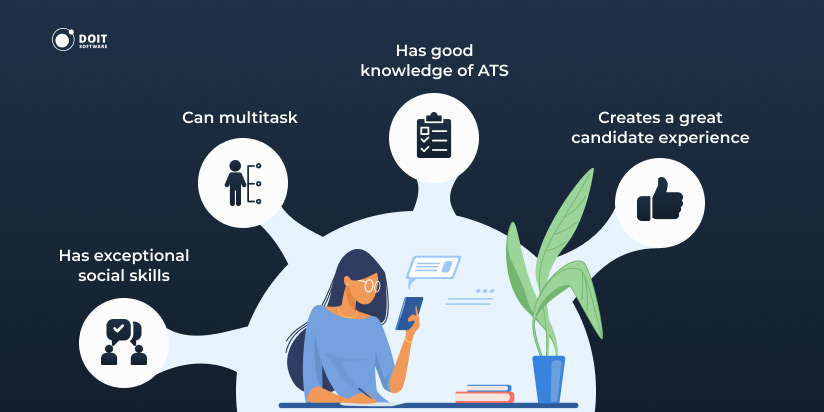
Although decent communication skills are important in any occupation, they become especially relevant for information technology recruiters. IT recruiters are the bridge that connects tech teams and potential employees, which is why they should present excellent interpersonal skills and find common ground with virtually anyone. On top of that, software engineers are often reserved and introverted, which makes it harder to establish a trusting relationship. Technical recruiters have to be true gurus of communication and negotiation.
Staffing specialists who are well-versed in communication can mitigate and resolve conflicts that happen in every team. Conflicts are usually expensive since they lead to project delays, missed handoffs, deadline slips, and worst-case project failures. Great IT recruiters and HRs will handle the situation and help each party resolve the conflict and find a compromise.
Technical recruiters have a lot on their plates, from composing job descriptions and screening candidates to preparing technical interviews and constantly reporting back to the employer. The job requires excellent time management, organizational skill, the ability to multitask without losing fidelity, and discipline around deep-work blocks.
A multitasker can juggle many things at the same time without missing deadlines. They can save an urgent project by quickly yet effectively finding an appropriate candidate to fill the talent gap.
ATS makes the recruiter’s work more efficient by analyzing applicants’ resumes and preselecting the ones that fit the role. ATS will evaluate the candidate’s experience, technology stack, responsibilities, and achievements as well as educational background to choose the best ones and ease the recruiter’s job. There are quite a lot of great applicant tracking systems on the market today, and most of them work in a similar way, so if a technical recruiter has had experience working with one or two of those, they will easily get a grip on your company’s ATS of choice.
Applying for jobs and going to multiple interviews where you have to be at the top of your game every single time can be highly stressful for candidates. Under that pressure, applicants might underperform and show lower results than they can actually deliver. The technical recruiter’s job is to make the candidate feel comfortable and deliver a good experience. It matters for the company’s reputation and referrals. It also matters because if your candidate has multiple offers from different companies, they will not choose a firm that left a bad impression.
The newest skill on the list is fluency with the AI tools that have reshaped sourcing and screening since 2024. A 2026 technical recruiter should know LinkedIn Recruiter’s AI matching, dedicated AI sourcing platforms, generative AI for drafting job descriptions, and at least one AI scheduling assistant. Industry certifications like AIRS and LinkedIn’s Talent Acquisition learning paths exist for recruiters who want a structured credential, but the practical bar is whether the recruiter can show you a sourcing list built from an AI tool and explain why each candidate is on it.
Without this fifth skill, a recruiter in 2026 is doing in two days what their peers do in two hours. That gap compounds across every role you hire.
AI has not replaced technical recruiters, but it has changed what they spend their time on. According to SHRM’s 2025 Talent Trends survey, 51% of organizations now use AI specifically for recruiting and 89% of those report time savings. The LinkedIn Future of Recruiting report adds that demand for AI-skilled talent acquisition professionals grew 2.3x over the past year.
The day-to-day of a technical recruiter in 2026 looks different from 2023 in a handful of practical ways. Sourcing is faster, since AI tools surface candidates who match a job description in seconds and rank them by signals like recent GitHub activity, public code repositories, technology history, and recent role tenure. A recruiter who used to spend half a day building a sourcing list now spends roughly 30 minutes refining one the tool already built.
AI also drafts most of the first-pass job description, which SHRM data shows is now true for about two-thirds of organizations. The output still needs editing by someone who understands the stack, but the blank-page problem is mostly gone. Resume screening has shifted in a similar way, with AI handling roughly 44% of the screening work and the recruiter still making the final call on every shortlist.
Scheduling tools round out the picture. AI assistants pull from calendars, pre-screen availability, confirm bookings, and chase no-shows without a back-and-forth thread. Across these four shifts, the aggregate gain comes out to roughly one full workday per week per recruiter.
What AI does not do is the high-judgment work: calibration calls (the meetings where a recruiter and a hiring manager align on what good looks like), evaluating culture fit, closing offers, or negotiating against a competing offer. Those parts are still the recruiter’s job, and they are the parts that decide whether the hire actually lands.
A US technical recruiter at the mid-level (2-5 years of experience) earns around $86,000 in base salary according to Indeed’s 2026 data, with senior recruiters reaching about $127,000 and director-level total compensation passing $186,000 per Glassdoor’s 2026 data.
Entry-level
0-2 years
~$48,800
$75,900-$132,700
Mid-level
2-5 years
~$86,000
$93,700-$162,000
Senior
5-9 years
~$127,000
$141,200-$250,800
Director / VP
10+ years
$156,000+
$186,000+
What is the best source for discovering technical recruiters? You can hire an in-house specialist who becomes part of your team. You can use the services of a recruitment agency. You can find workers on a recruitment platform. Each option has trade-offs, and there is a third path that often beats all three.
The benefits of hiring an in-house IT technical recruiter are obvious. An in-house worker becomes part of your team and is invested in the company’s success. They are more motivated to find the best people for the role because it benefits the company’s goals. The most common downside is high cost. You pay for the worker’s office space, equipment, benefits, insurance, and so on.
The second option is the services of a recruitment agency. Agencies usually have the resources to track down the technical workers you need. Tech recruiting firms work fast and precisely since they look for technical workforce all the time. They are familiar with technical requirements, current market trends, prevailing salaries, ATS shortcuts, and have access to databases like LinkedIn premium.
The biggest problem with technical recruiter companies is cost. For every successful placement, an agency typically charges up to 25% of the hire’s first-year salary. If an agency is your model, the breakdown of the best IT recruitment agencies covers fees, time-to-fill, replacement guarantees, and how to compare them. Some partners, including DOIT, replace placements with active knowledge transfer if a hire does not work out.
he recruitment-platform option exists too. Platforms like Reflik or independent-recruiter marketplaces let an independent technical recruiter sign in, pick the positions they want to fill, start working, and bill on placement. It is a large pool with thousands of recruiters, where you can find a dedicated worker. The drawback is the lack of vetting on the platform since anyone can sign in and work. You will have to handle interviews, background checks, and tests, and offer negotiation yourself.
DOIT Software’s recommendation is staff augmentation, an alternative hiring strategy that fills the talent gap in your team with one or several vetted experts. The IT staff augmentation services partner receives your requirements for the project, the exact skill set you need, sets up technical interviews, and evaluates candidates against your company’s criteria.
For the duration of the project, these workers become part of your team. You “borrow” their talent, skills, experience, and product-building abilities to fulfill a function and execute the project. DOIT’s technical recruiters work with developers who have built production software for startups and scaleups across more than a dozen industries.
Cost
The most expensive model (office space, dental, benefits, etc.)
One-time payment, however, they charge 25% of the hire’s annual salary
The most affordable model - you only pay the hourly rate of our top experts
Time
Up to several months to find a fitting in-house worker
On average, these agencies take one month to find a candidate
DOIT guarantees the first interview within 10 days
Quality
You run the vetting process yourself, so the outcome is on you
Agencies conduct screening and interviewing, so the quality is guaranteed
DOIT runs three interviews and evaluates candidate’s soft and hard skills - the quality is guaranteed
Over 10 years operating since founding in 2015, DOIT Software has helped startups and scaleups across the US, Canada, Mexico, the EU, and LATAM hire vetted developers, engineers, QA specialists, and technical leads. Here, we would like to share some tips on hiring the best talent in the IT industry.
“Great things in business are never done by one person. They’re done by a team of people.” Steve Jobs
One of the most important things that we have learned is the fact that people are your greatest and most valuable asset. You should make sure that your business goals correlate with your employees’ individual goals as well as ensure adequate work-life balance. But it doesn’t end with your employees – it also applies to your customers. Make sure they are at the center of your decision-making and your top priority. Build an authentic, genuine bond with your customers by welcoming them as a part of your community.
In the last several years, we have witnessed rapid development of the IT and AI market that has resulted in thousands and thousands of jobs. As a result, we have a scarcity of IT talent and an abundance of IT jobs. The situation is changing since more and more people are going into the IT-sphere after recognizing its potential, however, at this point, there is an obvious imbalance.
While IT experts are sitting back and choosing between the best offers that will bring them money and exciting projects, companies are left to compete for them. You have to be able to offer something special and interesting to work on, decent pay, which is quite high in the IT world, and some enticing perks. IT workers are more than aware of their privileged position and don’t waste their time on companies that they don’t think are not worth it.
So how do you stand out from the inevitable competition and land the crème de la crème?
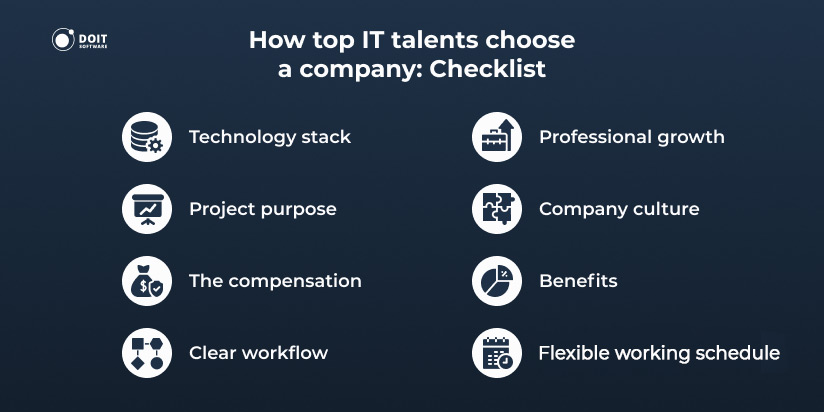
As it turns out, the salary is, although a significant factor, not the most important one in the candidate’s decision-making process. New technologies are far more crucial for the candidate since most of them are motivated by an exciting project. There are eight things that impact their decisions:
While benefits like free gym membership and free healthy meals bring quite apparent value to the employee, company culture does not seem that important. However, it is highly underestimated. The meta-analysis by University of Iowa has shown that there is a clear correlation between cultural fitness and employee retention rates. People who feel like a part of the team and fit in well with their coworkers are more loyal to the company and more satisfied with their job. Even when the company experiences downturns and volatility, they are more likely to stick around.

The technical interview is the step that actually evaluates a candidate’s skills and depth. Without one, you cannot make an informed decision about a developer’s level of expertise, logical ability, problem-solving, and ability to work with the existing team. Here are nine practical tips for running it well.
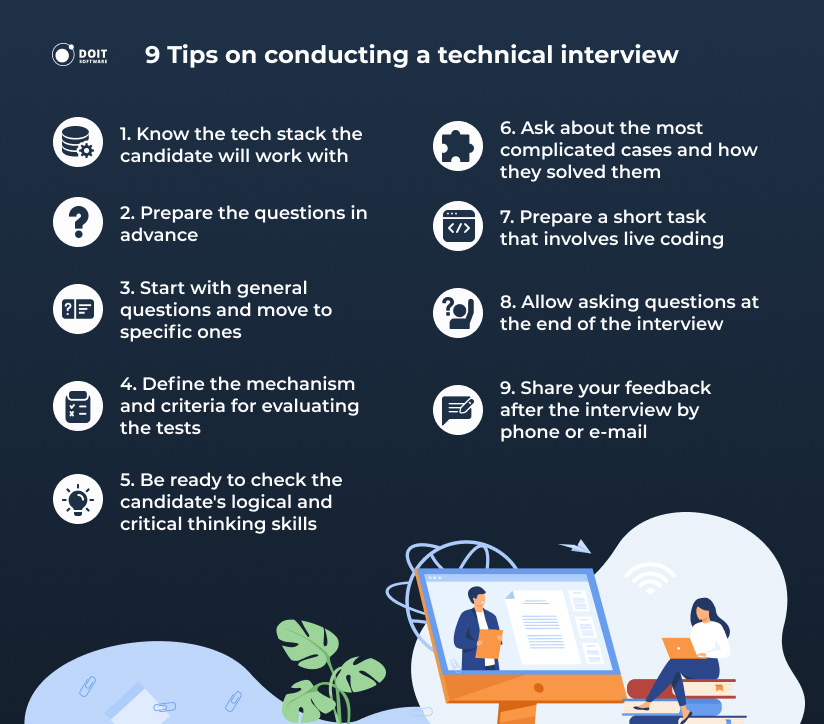
A good interview reads like a conversation about the work. Candidates who feel respected through the process are the ones who accept the offer when it comes.
DOIT runs a multi-stage screening process before any candidate reaches a client interview. Three things transform the outcome: the depth of the vetting process, the kind of talent DOIT looks for, and the mediator role DOIT plays between client and developer.
DOIT prioritizes culture-fit alongside technical skill. The team looks for people who share the company’s values around teamwork, professionalism, customer orientation, and self-development, with a high standard of work ethic. Beyond that, DOIT weighs candidate proactivity and the willingness to take initiative as a heavy signal.
Having delivered many engagements for many clients, DOIT has concluded that the alignment between the developer’s work and the company’s expectations is the most important driver of project outcomes. That is why DOIT runs a quarterly feedback process between clients and the professionals on the project.
The best part of the approach is the speed of response to misunderstandings between the two sides. For example, if DOIT receives negative feedback about an employee, the team quickly organizes a meeting that surfaces the issues, gives the employee a chance to respond, walks both sides through next steps, and supports everyone through the resolution.
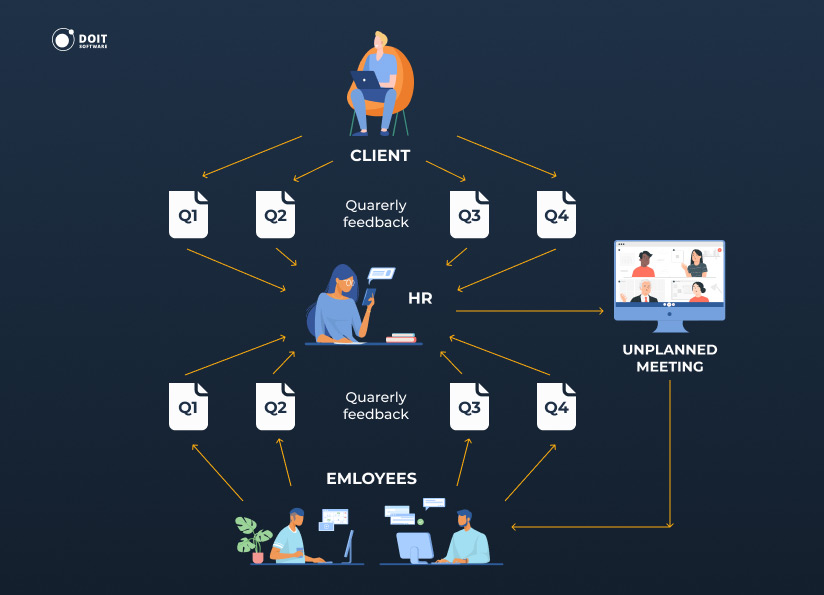
Our strategy enables the perfect labor divisions where DOIT Software handles HR and administrative tasks, developers can focus on writing code, and the company’s executives can think about the big picture – long-term goals, strategies, and future projects.
The unique technical recruiter skills and competencies DOIT offers will help your company find workers that ideally fit into your company, share your values, and bring in the exact set of skills that is required for the position. The expertise and knowledge that IT recruiters possess will save your company money and time as well as establish the culture that will make your business stand out and attract the right people.
DOIT Software offers a unique approach to hiring IT personnel that has already shown its benefits for businesses. By using our IT staff augmentation hiring model, you will shorten the hiring process, lower the costs, and receive the best experts for the required roles. Contact our team of professionals to get a consultation and ask any remaining questions about staff augmentation and software development.
A technical recruiter is a recruiter who finds and hires talented prospects in the IT-sphere. Tech recruiters are a part of the HR department and take care of finding, interviewing, hiring, and onboarding IT staff.
According to Indeed (2026), the average US technical recruiter base salary is roughly $86,000, with senior technical recruiters reaching $127,000+ and director-level total compensation passing $186,000 per Glassdoor (2026). Pay scales with the seniority of roles you place and whether you work in-house on a fixed salary or at an agency on commission.
No, and most do not. A technical recruiter needs enough literacy to read a job description, understand the difference between a backend and a frontend stack, tell a Python role from a Node role, and check a candidate’s GitHub profile. They do not write production code.
A good IT recruiter is a professional who can assess a candidate’s personality traits and soft skills as well as is knowledgeable enough to evaluate their technical skills.