
Hiring a CTO (Chief Technology Officer) is one of the most important decisions a startup founder makes. The person you bring in decides your product technical direction, hires the developers who build it, sets the quality bar, and defines the engineering culture for your future team. That choice affects the company for years, which is why learning how to hire a CTO well is worth the effort.
A wrong choice is one of the most expensive hiring mistakes a startup can make. The cost of a failed executive hire runs 10 to 15 times annual salary. Severance, vacancy cost, recruiting fees, and the morale hit all stack on top of that.
Most founders running this search are doing it for the first time. Candidates are hard to read from the outside. So let’s start with the first question every founder hiring a CTO should answer. When to hire a CTO, and what kind of CTO fits the company right now?
If you are figuring out how to hire a CTO for a startup, the first question is timing. A CTO can join a startup at almost any stage. And each stage uses the role differently.
Many non-technical founders hire a CTO as their first technical hire. Here the CTO writes code, leads the first few developers, and sets the long-term technology direction at the same time.
As the team grows past ten developers, the same Chief Technology Officer usually moves out of day-to-day code and into pure strategy, while new engineering managers take over the team leadership. The path is common and is one of the standard ways a startup builds its early technology function.
Other founders take a different path, where a technical co-founder or a senior developer does the early build. Here the company waits to hire a CTO until the developer team is large enough to justify a strategy-only role. Both paths work. The right one depends on whether you already have someone writing code while also leading, or need a CTO to do both.
Non-technical founder, no technical co-founder, pre-product
Hands-on founding CTO
Writes code, builds the first product, hires the first developers, sets strategy
Technical co-founder is doing the build
Senior developer or tech lead first
Adds capacity to the build, with a CTO later as the team scales
Engineering team has grown past ten developers, no CTO yet
Strategy-only CTO
Owns technical strategy, the development team at the executive level, board representation
Engineering team is twenty or more, current technical leader is overloaded
Strategy CTO with VP Engineering layered in
Splits the work between strategy and execution leadership
A growing startup faces daily decisions on architecture, hiring, vendor choices, or roadmap tradeoffs, and a non-technical founder can’t judge every one of them on real technical grounds. A senior tech lead can take a few of these decisions per week. But once the number grows, you need someone who owns the full technical agenda.
Once your development team passes about ten people, coordination becomes a full-time job. And a tech lead writing code half the day can’t also run hiring and review architecture across several teams. The main problem at that size is about managing people, and the moment when the CTO role is worth the cost shifts forward.
Early signs that the team has grown past one tech lead include the following common scenarios:
A few of these signals on their own are not emergencies. Together, over a few months, they tell you the company has reached a size one tech lead can’t cover.
You reach the point where the product roadmap depends on big technical decisions. A senior operator who has lived through similar decisions at a similar stage will save the company more in mistakes avoided than the salary costs.
Founders making these decisions on instinct usually find out within a year that the cost of an experienced hand is far lower than the cost of a wrong choice.
You usually feel this change when the product roadmap turns on a technology choice you can’t fully evaluate. Once those decisions are on the table, a CTO becomes the most important hire for the company’s roadmap.
A non-technical founder who hasn’t yet shipped a product is exactly the kind of founder who benefits from a hands-on founding CTO. The right candidate at that stage is comfortable writing code while leading. They stay in that mode for the first 18 to 24 months as the company moves through product-market fit.
The work means choosing the stack, building the first version of the product, hiring the first 3 to 5 developers, and setting the technology direction at the same time. Some startups hire a founding engineer first and add a CTO once the team grows past the original founder’s reach.
A hands-on founding CTO is harder to find than a strategy-only CTO. You need someone willing to write code while also owning the broader strategy. The candidates who fit this profile usually come from a senior developer background with a strong technology vision and a real interest in early-stage product work.
Equity expectations depend on whether the candidate joins as a true co-founder or as a hired CTO. Equity ranges by stage break down as follows:
The co-founder range carries founder-level risk. This is why the role often carries the title of technical co-founder, with the CTO label coming later.
You might be wondering if you even need a CTO given recent technology shifts. With modern AI tools like Claude Code and Cursor, a non-technical founder can now build and scale products that previously required a dedicated engineering team. You can write code and fix bugs directly with these AI assistants, and even handle your own deployments.
This explains why solo founders are on the rise. Historically, solo founders made up about 10% of Y Combinator batches. Recent Carta report shows solo founders now start over 36.3% of all new companies.
So you might think that a single person using AI coding tools and workflow automation platforms like n8n or Zapier can match the output of a small traditional team. And yes, using AI to delay a full-time executive hire makes sense when you are still proving your MVP. It saves your budget and protects your equity while you search for product-market fit.
But this approach hits a wall the moment you close your first investment round.

AI assistants are excellent at shipping basic features, but they don’t know how to architect for scale or manage deep database infrastructure. As your user base grows, the AI-generated codebase quickly becomes too complex and fragile for a non-technical founder to navigate alone.
When you reach that investment, your main challenge shifts from validating an idea to building a reliable commercial platform. And most investors will likely expect you to build a reliable, scalable engineering infrastructure for your product.
This is exactly where the choice between an expensive executive search and on-demand capacity comes into play. You don’t have months to wait while looking for a permanent executive just to keep your product moving. You need senior hands to clean up the early build and scale production immediately.
For founders navigating this transition, a senior tech lead via staff augmentation often arrives in days rather than the months a full executive search takes. This gives you the engineering depth to support your new funding round while you take your time defining what your permanent CTO role will look like.
Understanding what a CTO does at a startup is part of how to hire a CTO well. A startup CTO owns two things that no one else in the company replaces. They own the technical strategy and the development organization that builds it, and they own board-level technology representation for the company.
The CTO’s work moves from hands-on coding at the early stages to organizational work and strategy as the company grows. A CTO at a ten-person company spends most of their week in code and customer conversations. A CTO at a hundred-person company spends most of their week in one-on-ones and board prep.
The role definition matters more than founders usually think during the hiring process. Two CTOs with similar resumes can be very different hires for a company. The right one depends on which of the jobs the company actually needs done.
A CTO owns build-versus-buy decisions, architecture choices, technology stacks, and the 12-to-24-month roadmap. They own what gets built, and not only how it gets built. A senior tech lead can carry out a strategy that someone else has defined, but the CTO is the person who decides the strategy in the first place.
A CTO is responsible for hiring, team structure, development culture, and performance management at the senior developer level. They set the bar for what a developer at your company is allowed to ship. How the team around a CTO comes together directly affects how quickly the product can move.
The CTO’s organizational work changes with the company size. Each headcount band asks them to do something different. At ten developers the CTO focuses on hiring and culture. At twenty-five developers they build the first layer of engineering managers. And at fifty developers they handle the split between platform and product along with the introduction of staff developers.
Each of those steps is a separate skill. A CTO who has done the ten-to-twenty-five step well isn’t automatically the right person for the twenty-five-to-fifty step. That mismatch is one of the most common reasons the company replaces strong CTOs as it grows.
In the board room, a CTO carries two jobs that a senior tech lead can’t. They defend technical investment and the technology direction in front of investors, and they own the conversation about whether the technology gives the product a real competitive advantage.
The development team rarely sees the board work. The CTO spends a real share of their time on it at any funded startup. Investors expect a good answer on technology direction or on how the development budget turns into product outcomes. A CTO who can’t hold their own in those conversations creates problems that come back to the development team in the form of investor-driven changes to the product roadmap.
The right title for the next hire depends on which of the jobs above is the current bottleneck in the company. Here’s how each role compares.
CTO
Technical strategy, the development team at the executive level, board-level technology representation
The strategic bet is technology, the team has more than ten developers, or you are a non-technical founder who needs a hands-on technical leader from the start
VP Engineering
Day-to-day execution, team leadership across the whole development org, delivery speed
The strategy is set and the main problem is steady execution across multiple teams
Senior tech lead
A single team’s technical work and the few hires around it
The team is under ten developers and the work is mostly hands-on technical leadership
A common mistake founders make is hiring for a CTO title when the actual gap is execution leadership. The result is a strong strategist sitting at the top of a company that needed a strong operator. The strategist gets bored, the developers feel under-managed, and the founder ends up running a second search inside 18 months for the senior tech leads they should have hired first.
With the role defined, the next step in how to hire a CTO is choosing the engagement model.
Each engagement model fixes a different problem at a different price point. Picking the wrong engagement model usually costs more. The engagement type sets what kind of work the CTO can do once they are hired.
A useful way to think about the choice is to ask how many hours per week the role really needs and how long the work will take. A full-time CTO at a funded growth-stage company easily fills 40+ hours of meaningful work per week. A fractional CTO at an earlier-stage company often delivers more value per dollar because they focus on a defined problem.
A full-time CTO works for you when technology is the company’s central strategic bet, and the role will fill 40 or more hours a week for at least the next 18 months.
You get the most out of the role when the gap is really about strategy and when you have the time and money to find the right person.
You see the fit break down when the actual gap is execution capacity and a senior developer would close it. Hiring a full-time CTO in that situation is the most common expensive mis-hire in early-stage startups.
A reasonable test for the full-time fit is to write down what the CTO will be doing from week one, week ten, to week one hundred. If you mostly write about hands-on architecture, hiring, strategy, and board prep, the role fits.
When you want to hire a fractional CTO, the fit is right if you need senior strategic input but can’t justify the full-time cost yet. Monthly retainers in the US market run $8,000 to $25,000 depending on hours per week. Most B2B SaaS engagements settle around $15,000 per month at two days a week. Engagements typically start in days, which makes them useful when the company has a specific deadline.
Some founders search to hire a part-time CTO or hire a virtual CTO. This usually means the same arrangement under different labels, with the virtual version simply working fully remote. Anyone trying to hire fractional CTO support should know up-front that they deliver real value on scoped work and lose effectiveness when you stretch them into open-ended ownership.
You get the most out of a fractional CTO when the engagement matches a real problem. Common situations include the following:
If you hire a fractional CTO and ask them to act as a full-time CTO at fractional cost, the arrangement will fall apart. If you really need a full-time CTO, treat the fractional engagement as a temporary fix while the full search runs.
If the company’s real gap is AI leadership specifically, you can hire a fractional Chief AI Officer on the same model with a more specialist profile. The fractional model works cleanly for specialist executive roles when the real need is bounded.
When you decide to hire an interim CTO, you are covering a full-time-hours need for a defined period. The engagement usually starts after a departure, a fundraise, an acquisition, or a CEO change. Most interim engagements last 3 to 9 months. You pay more than for a fractional CTO but less than the all-in cost of a full-time hire. An interim CTO is a temporary fill while you run the search for the permanent hire, never a replacement for that search.
An interim CTO does two things well during the transition. They hold the development team together and keep the existing roadmap moving, and they represent the company to the board while a missing CTO would worry investors.
The work an interim CTO won’t do well is making the long-term technology decisions. They know they won’t be there to see them through. Founders who try to use the interim engagement to also decide the technology direction usually end up redoing the work when the permanent CTO arrives.
Monthly cost
$30K-$55K all-in
$8K-$25K retainer
$20K-$40K
Time to start
3-6 months
Days to weeks
2-4 weeks
Equity expected
0.5%-2% post-funding; 10%-25% co-founder
Rare; some take advisor equity
Rare
Ideal stage
Tech is the strategic bet
Need strategic input, scoped
Filling a transition
Primary risk
Wrong fit, hard to undo
No full-time hours
Not the permanent answer
Now let’s talk about how to hire a CTO on a reasonable budget. In general, CTO’s compensation varies a lot by stage and by industry. AI and fintech specializations earn a premium of around 15 to 30% above the base, while remote-friendly hires from outside the US tech metros can be 20 to 40% below the bands. The average CTO base is $329k, with a 25th to 75th percentile of $250k to $442k.
Compensation conversations get tricky because the numbers feel large in isolation. A $300k base for a CTO sounds expensive until you compare it to the cost of a wrong hire or the all-in cost of leaving the role open.
Startup CTO base averages $157K with a $150K median. Let’s compare base salaries of CTOs based on the company stage in the US.
Pre-funding co-founder
$0-$120K
10%-25%
Founder economics
Early-stage funded startup
$150K-$220K
1%-3%
$400K-$650K
Mid-stage growth company
$200K-$320K
0.5%-1.5%
$500K-$800K
Late-stage or public company
$320K-$450K+
0.1%-0.5%
$600K-$1M+
Equity compensation needs more care than founders usually give it during the offer phase. A CTO joining a strong company at 1 percent post-funding equity is usually better off than a CTO joining a weaker company at 3 percent.
Get the candidate to focus on the expected value of the whole package. The headline percentage matters less than what the package is realistically worth. The expected value depends on the company’s stage, the funding round size, the dilution schedule, and the realistic exit assumptions over the next several years.
The all-in number for a full-time CTO hire includes more than base salary and equity. Add benefits at around 25 percent of base, recruiting fees at 15 to 35 percent of first-year compensation if you use an executive search firm, a severance reserve, and the cost of a 2-to-6-month period where the role sits open while the search runs.
The real Year 1 all-in for a full-time hire often clears $500K once you include every line item.
Monthly retainers for fractional CTOs run $8,000 to $25,000 depending on hours per week. Hourly rates run $200 to $500. Advisory-level engagements at five to eight hours per week run $3,000 to $5,000 monthly. Per year, the cost of a fractional CTO lands at $90K to $300K, which is roughly a third of full-time.
With the cost picture clear, let’s talk about how to find a CTO for your startup.
CTO recruitment runs across five channels worth using in parallel, and each has a clear case for when it is the right call and when it isn’t. Let’s take a further look.
Personal network and founder communities
4-12 weeks
Free (or referral bonus)
Stage-aligned network in the right industry
VC and investor introductions
Varies
Free (relationship cost)
Lead investor has placed CTOs at stage-similar companies
Executive search firms
6-12 weeks
25%-35% of first-year comp
Bounded search, clear role definition, budget in place
Fractional CTO marketplaces
Days to 2 weeks
Engagement-based
Scoped fractional engagement, low long-term commitment
Specialized tech hiring partners
2-4 weeks
Success fees or monthly/hourly engagement rates
A vetted specialized tech search matched to your stage, technology, and team fit
A founder’s own network is the cheapest channel and often the slowest. Your existing relationships carry the reference layer, which makes the signal strong when it works. The channel works best when your network is at the right stage and in the right industry. It works poorly when your network is in nearby stages. The candidates you find will usually be the wrong stage match.
Ask specific founders who they would hire if they were running your company today. The question is more useful than asking for general introductions. Founders one or two stages ahead of you know the names of the people who would be right for your stage now. Those are the people they looked for one or two years ago.
A lead investor who has seen hundreds of CTOs is usually the best source on the market. The bias to watch is that the introductions tend to come from the VC’s own portfolio. The channel is most useful when your lead investor has placed CTOs at multiple portfolio companies at your stage. It is less useful early on, when your investor’s other portfolio companies haven’t yet reached the stage you are at.
An executive search firm, sometimes called a CTO headhunter, is the fastest channel for getting a structured shortlist. The cost is real, with most firms charging 25 to 35 percent of first-year compensation, paid up-front. The average cost-per-hire for executive roles reaches $39,879, up 113 percent since 2017. The channel is the right call when the search has a clear deadline, the budget is in place, and the role definition is clear.
One of the biggest factors in success with a search firm is the role brief the founder writes before the engagement starts. A loose brief produces a generic shortlist of executives who don’t match the company’s actual problem. A clear brief produces candidates who are already a match on stage and on technical area.
If you want to find a fractional CTO quickly, a marketplace is the fastest way to start, with most engagements starting within days. The tradeoff is that the depth of the relationship is limited and the commitment level is low.
A CTO for hire on this model fits when the engagement matches a defined problem and the gap is strategic input. It is the wrong call when the company really needs long-term ownership. Fractional candidates usually take on many short engagements, and they rarely commit to one.
The marketplaces vary widely in quality. The strongest ones check their candidates with reference checks and past-engagement reviews. The weakest ones work more like LinkedIn with a thin layer of curation on top. You should ask how the platform checks the candidates it lists and how disagreements between fractional engagements and companies are handled.
A tech recruitment and staff augmentation partner differs from a general executive search firm in one important way: the recruiters know technology first-hand. They can evaluate a candidate’s technical depth and vet for the leadership traits a startup actually needs. They bring you CTO candidates already filtered against your stage and stack, which differs from a generic executive-hiring process.
DOIT Software is one such partner. Since 2015, we match startups with experienced CTOs, engineering managers, founding engineers, and CAIOs across the US, Europe, and Latin America.
When you need a permanent CTO, DOIT can run the search for you. The tech recruiters start from your specific needs (stage, technology, team, and business context) and bring you a shortlist of candidates who match your criteria. You interview only the top 5% of tech leaders from the network.
When you need someone faster, the staff augmentation model can bring a senior technical leader onto your team within weeks. You choose the location that fits your team’s time zone and your budget. For remote-first leadership, we find candidates in the location that suits your team.
What you get when you hire a technical leader with DOIT Software:
If you want to find your next technical leader, tell us what you need and DOIT will send the first relevant candidates within days.
Knowing how to hire a CTO means running a structured interview process. The whole CTO interview process usually runs four to six weeks from first conversation to offer. The full-time search itself averages three to six months, with C-suite searches running 60 to 120 days from launch to accepted offer. Let’s take a further look.
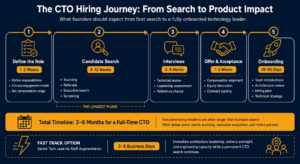
The goal of the first conversation is fit, vision alignment, the candidate’s reason for wanting this specific company, and an early read on how they think about the business. Forty-five to sixty minutes is enough. The sign to listen for is whether the candidate asks questions about your business model, your customers, your runway, and your competitive position, or whether they only ask about the tech stack.
Useful questions to ask in the initial conversation stage:
Candidates who ask follow-up questions about your unit economics, customer acquisition cost, revenue concentration, and the size of the team they would be running show they think about technology in business context.
The goal of the second stage is to see real technical judgment in action. A ninety-minute working session on a current architectural problem in your codebase shows more about how the candidate thinks than a generic coding test would.
A workable structure for the ninety-minute session:
Watch how the candidate works alongside your team. Some candidates teach the team something new about the problem; others just mirror back what they have heard and can’t share insights.
The goal of the third stage is to understand how the candidate has handled people decisions in the past. Ask for specifics on three past hires the candidate made. Listen for what they looked for, what they got wrong, what they would repeat, and what they would change. A candidate who can walk you through a specific past situation usually has the self-reflection to learn from the next one.
Add a question on a hard performance conversation the candidate has run. Ask them to walk you through what they said, how the developer responded, what the outcome was, and what they would do differently.
Close the stage with a forward-looking question. Ask the candidate what their first hire at your company would be and why. The answer tells you how the candidate reads your stage and the limits you work under.
Reference checks give the strongest signal of any stage when you run them well. The approach is to call references, specifically peers and direct reports from past roles. Here is what to ask:
References outside the candidate’s list can fill in a more complete picture. Past LinkedIn connections often share a different perspective from the references the candidate chose.
Run at least four reference conversations before you make an offer, with two from the candidate’s list and two from outside the list. Take notes during the calls themselves, since quick side comments often carry more information than direct answers to the questions you asked.
The final step in how to hire a CTO is the closing conversation. Let’s talk about how to close the offer and plan onboarding of your new CTO successfully.
Base the offer on total compensation, with the base salary number as one input into a larger package. Most senior CTOs care more about scope and the equity package than they do about the base number.
Don’t auction the role against a competing offer if you can’t match it. Losing the candidate cleanly is better than overpaying and regretting the hire later.
You produce clean offers by sharing the structure of the package early in the process. By the time the offer conversation arrives, the candidate should already know the rough cash and equity band, the vesting cliff, and the rough timing of the start date. Surprises in the offer conversation create friction you usually have to deal with later. When you line up the structure earlier, the actual offer is about the specific number and not the format of the package.
Write down what success of your hired CTO should look like at the first quarter, half of the year, and year marks before the offer goes out. Share the document in the final conversation. The candidate either signs the offer with a defined role in front of them or raises any disagreement before they accept the offer.
A useful structure for the document includes the following markers:
In the first thirty days, the new CTO should focus on listening, one-on-ones with every developer, a tour of the codebase, and a list of the current vendors and tools. After, they should produce two documents, including a hiring plan covering the next 6 to 12 months, with rough headcount and role definitions, and an annual technology strategy document with defined architectural direction.
During onboarding, the founder’s role is to clear the way and let the CTO direct the work. Make sure the CTO has access to every internal system and every customer conversation they ask to join. They also need every board document from the past periods.
Don’t give the CTO a list of first things to fix. The CTO should come up with their own list, since the list itself is part of the work the role is being paid for.
Put weekly, monthly, and quarterly check-ins on the calendar before the CTO’s start date, plus a six-month review for the longer-term role definition.
There you have it. We hope this guide gave you a clear picture of how to hire a CTO for your startup well. All in all, knowing how to hire a CTO is a sequence of decisions. You choose when to make the hire, what kind of engagement fits, what to look for in candidates, where to find them, and how to successfully close the offer.
If you want help with the search, talk to DOIT Software. We can run the permanent CTO search for you, or place a senior technical leader on your team for a long-term engagement. Both paths start with a vetted shortlist matched to your specific requirements. Tell us about your search and we will send the first relevant tech leader profiles within days.
Get a consultation and start building your dream team ASAP.
Request CVsA full-time CTO search takes 3 to 6 months on average. C-suite searches run 60 to 120 days from launch to accepted offer. The timeline grows to 4 or even 6 months once you add executive-search-firm steps and notice periods. Fractional and interim engagements usually start within days.
Equity ranges shift by stage. A pre-seed co-founder CTO typically holds 10-25%. A hired CTO at seed earns 2-5%. At Series A the band tightens to 1-3%, and at Series B to 0.5-1.5%.
The right number depends on stage, candidate’s track record, and base salary they accept. Focus on the total package the candidate is being offered.
Most first-time non-technical founders hire their first CTO this way, and many of them go with the hands-on founding CTO path where the CTO writes code while leading for the first 12 months.
The key is building an interview process that tests for outcomes you can check: past products shipped, the size of the teams the candidate has run, the quality of the references they offer, and the way the candidate explains past projects. Ask the kind of questions a domain expert would ask, then check the technical depth through references who can grade it for you.
When thinking about how to hire a CTO, founders often confuse the role with adjacent titles. A CTO owns the technical strategy, the development organization, the board-level technology representation, and senior development hiring at the executive level. A VP of Engineering runs day-to-day development execution and team leadership across the whole org. A senior tech lead runs a single team’s technical work and the few hires around it.
Many early-stage startups bring in a senior tech lead first, layer in a VP of Engineering as the team grows, and add the full CTO role at the executive level after that. The right title for the next hire depends on which of those three jobs is the current bottleneck in the company.