With Python still keeping its position at the top of the list of the most used programming languages in the world, Go is starting to crawl up the ladder. Even though in Go vs Python the latter is still in the lead with 57.9% of developers using it for their work, Go is gaining more traction and comes in at 16.4%, according to Statista.

What makes Python so popular that it has stayed on top of the competition for so long? What is Go programming and why use Golang for software development? In this article, we will discuss the advantages and disadvantages of Python and Go, and try to establish which one of the languages is best suited for your next project.


GO: The basics you should know

The popularity of Golang comes from its high security, speed, and modularity. More and more companies choose this technology for their products in various industries, such as FinTech. So what is Golang? Let’s talk about the history of the language and cover the pros and cons of using Golang.


What is Go?

What is the Go programming language and why are we talking about it today? Go coding language was developed in 2007 and introduced to the public in 2009. It has come a long way and nowadays joined the club of the most used languages for software development. The purpose of creating Golang was to simplify the software development process and provide a more simple and relatively performant alternative to programming languages such as C++.
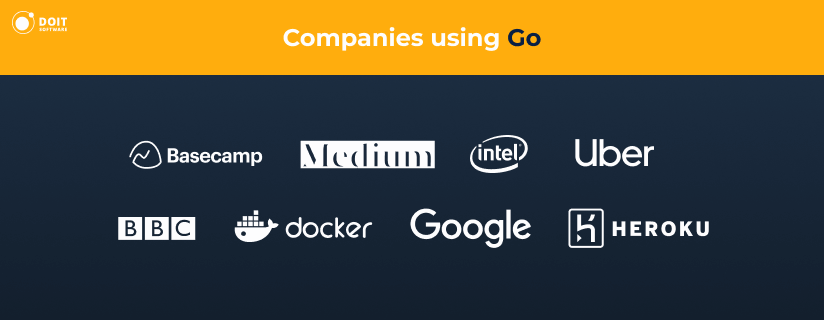
go vs python companies using go
With big players like Google, Uber, Twitch, and Cloudflare using Go for their systems, and major tools like Docker and Kubernetes built with it, Go is gaining more and more relevance in the tech community. But what is Go programming language used for and how can it benefit your business and technical operations?


The pros of using GO

01
Easy to learn
Especially for developers who have worked with C++ and C#, Golang is relatively easy to master. The simplicity of Go's syntax also makes it a great choice for programming newbies.
02
Speed
Another advantage is Golang speed which allows you to build and compile extremely fast. Go is compiled directly to machine code which gives it a great benefit compared to languages that work through virtual runtimes. As a result, developers can write programs faster and deliver high-performance applications quicker.
03
Security
High security is another advantage of Go that is derived from its simplicity. Go is a statically typed language that does not require complex structures, which makes error detection easier. On top of that, an integrated garbage collector makes sure your memory stays intact.
04
Feature-rich library
Another one on the list of Golang advantages that comes with the language is its standard library. Many languages require additional secondary libraries that might generate conflicting function names and complicate the process. Go's feature-rich library is full of sufficient tools that make the process of development easier and quicker.

The cons of using GO

01
Smaller library selection
Go's library selection is narrower than what you get with Python or Java. For some tasks you will find fewer ready-made packages and end up writing more yourself, or leaning on community tools from GitHub. That selection keeps growing, but Python still gives you more off-the-shelf options for most jobs.
02
Time-consuming
As Golang is a strictly compiled language, in the Go vs Python comparison, it loses a point. Due to Go's nature, developers have to spend a much longer time on writing boilerplate code. What you can accomplish with just a few lines using Python, you will need dozens of code lines to get there with Golang.
03
Verbose error handling
Go keeps error handling explicit, so developers check for errors after almost every call. It makes programs predictable and easy to follow, but engineers coming from other languages often find the repeated checks verbose and a bit tedious to write.
04
Narrow focus
Go is built for backend services and infrastructure, and that is where it is strongest. It is not the tool you reach for on the front end, where JavaScript dominates, or for data analysis and visualization, where Python leads.

The list of benefits and disadvantages is difficult to perceive without any comparisons. In the following sections, we will dive into Python’s strengths and weaknesses and compare their features in a simple overview.

Python: The basics you should know

In our Go vs Python article, we will also dive into the definition as well as the advantages and disadvantages of Python. Python is a dynamic-type programming language that has been on the market for nearly three decades. It can be used for a very broad selection of projects and systems, including complex tasks like machine learning programs and network servers. With clients like Google, Facebook, Netflix, NASA, and others using Python for their projects, the language has become one of the most used technologies in the world.
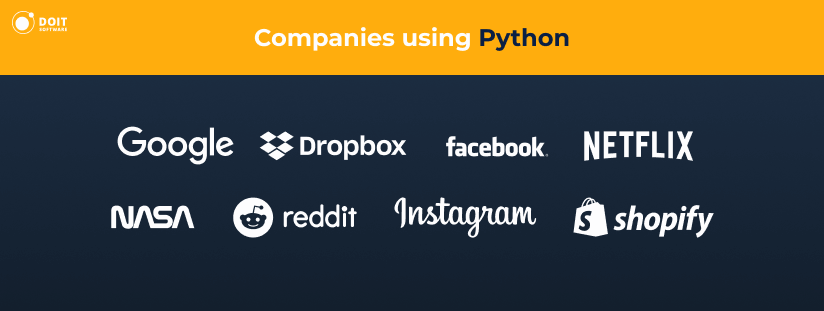
go vs python companies using python

What is the Python programming language?

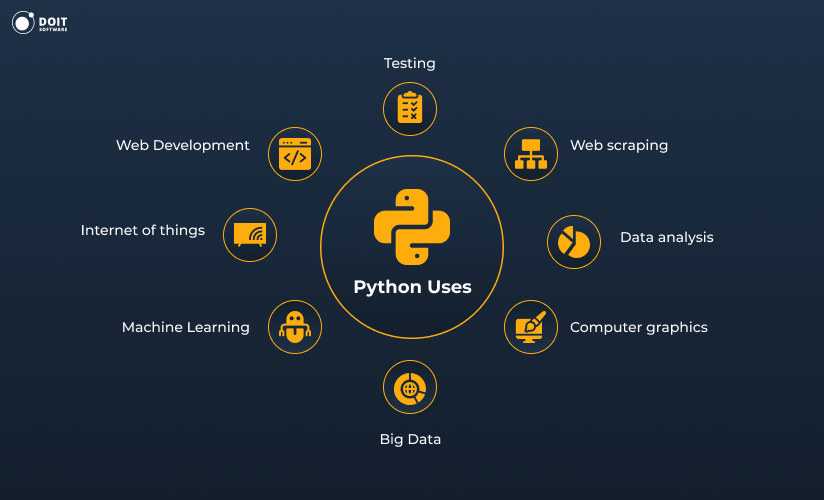
Python is a popular general-purpose language that can be used to power the backend for web development, facilitate big data processing, including complex mathematical computations, as well as write system scripts, and even enhance automation, for instance, through the use of a SERP Scraper.

Python is often referred to as a “glue language” that allows the front and back ends of your application to smoothly work together. Even though Go is in many ways one of the languages similar to Python, there are many points where they differ. Let’s talk about Python’s benefits and downsides in more detail to have a clearer distinction between Go vs. Python.
 

The pros of using Python

go vs python python uses

01
Data visualization
Python is the go-to technology when an application requires advanced data analysis and visualization capabilities. Large tech and fintech companies take advantage of Python libraries like Matplotlib, Seaborn, and ggplot to create dynamic and easy-to-read graphic reports.
02
Prototyping
Python’s simplicity and agility allow to utilize Python development for prototype building. Easy code refactoring and accelerated development process deliver high-quality prototypes that can be made into a final product in the future.
03
Versatility
Python is incredibly versatile, especially if we compare Go vs. Python. The variety of available libraries and frameworks allows you to pursue web development, IoT and Machine Learning development, and even improve automation within your organization using, for instance, Python crawlers.
04
Asynchronous programming
Asynchronous programming is one of the up-and-coming trends in the software development world as it allows one to run code blocks separately and address issues quicker and more efficiently. Python, as well as Go, supports this technique and facilitates faster bug detecting and fixing.
05
Large community
In Go vs Python, the latter is a much more mature language that has successfully created a huge community of enthusiasts and contributors who play a major role in language development. On top of that, many active developers are ready to share their tips and experience on platforms like GitHub, which shortens the learning curve for beginners.

The cons of using Python

01
Speed
When we discuss programming languages speed comparison, Python is not a winner. Being an interpreted script language, Python is behind compiled languages like C or C++. In the language speed comparison between Go vs. Python, Python takes longer to translate code and slows down the development process.
02
Lack of mobile development support
Although it is versatile and can be used for mobile development, many companies believe that Python is weak in this department. If you are working on a mobile application, Python should not make your shortlist of technologies.
03
Memory
When it comes to memory-intensive applications, Python is not the best choice. Its diversity of data types, unfortunately, puts a constraint on memory.

GO vs Python: Which one should you choose for your project?

The advantages and disadvantages of Go vs. Python are sufficient to have the first impression of what these languages are about. However, what is the Go language used for and when should you choose it over Python? If you have a Machine Learning project, should you pick Golang or Python? In this part, we will conduct a thorough Go against Python comparison to establish which technology would suit your next project best.

go vs python


Detailed comparison of Go vs Python programming languages

Which technology gets the most points in Python vs Golang performance, speed, community, and so on?

01
Performance
When we talk about performance, we usually mean performance at runtime. Multiple tests show that Go runs up to 30 times faster than Python. Thanks to Go's support for concurrency, it executes calculations significantly faster compared to Python.
Go vs Python performance: Golang wins.
02
Speed
What Golang is good for is delivering fast and frequent deployment of server-side scripts. This is due to its high-performance concurrency and parallelism. Especially for systems programming, Golang takes the lead when it comes to programming language speed comparison.
Google Go vs Python speed: Golang wins.
03
Scalability
Again, excellent concurrency and parallelism allow Go-based solutions to expand and shrink. Since it was developed by Google and for Google, it was built to scale up and down with the company's needs. The Global Interpreter Lock holds Python's threading back, which makes it harder to scale for CPU-heavy concurrent work.
Python vs Go scalability: Golang wins
04
Libraries
Having been on the market for 30 years, Python has attracted many users and companies. This large community of supporters actively contributes with modules, packages, libraries, and success stories. Go is a relatively new technology that lacks this support and is only in the process of building a strong community around itself.
Golang vs Python libraries: Python wins.
05
Frameworks
Python has a wide variety of libraries and frameworks that accelerate and simplify the software development process. Django and Flask are to name a few frameworks that are actively used for web development. So, If you need to build applications in a shorter time, you definitely should hire Python experts. On the other hand, Golang does not have a single ingrained framework that is used for Go-based projects.
Python vs Golang frameworks: Python wins.
06
Prototyping
Python is an ideal choice for prototyping due to its dynamic nature. Even if you don't know exactly how it works, having basic knowledge would be enough to quickly build a prototype and raise necessary funds for future development. Go is static which makes it stricter when it comes to compilation. You will not get by with just basics, even if you are building a simple prototype.
Go language vs Python prototyping: Python wins.
07
Machine Learning
Choosing Golang for Machine Learning is one of the popular options among the tech community. Although Python is still in the lead, Go’s high performance and speed entices many developers to choose it for their next project. Building Machine Learning with Go is a valid decision, however, the lack of frameworks in the Golang community drives many developers towards Python.
Go vs Python for Machine Learning: Python wins.
08
Web development
First of all, Go requires more coding which makes the process longer and more error-prone. Secondly, Python has a bigger choice of mature frameworks for web development. However, Go has one valid advantage: as it is a statically typed language, it detects errors early on, unlike Python that catches mistakes at runtime.
Go vs Python for web development: Python wins.
09
Deep Learning
Golang for Deep Learning poses the same risks as Machine Learning development does. The lack of external frameworks that developers are familiar and comfortable with usually puts them off. However, there are AI-affiliated frameworks like GoLearn and Gorgonia that make Go more appealing for Deep Learning and Machine Learning purposes.
Go vs Python for Deep Learning: no clear winner
10
Data science
Python is still the number one language when it comes to data science and analytics. Its great ecosystem was built and extended with more and more libraries and frameworks that support math, AI, distributed processing, statistics, and so on. Go has been making progress in AI-related technologies, however, Go for data science still lacks maturity and community support.
Go vs Python for Data Science: Python wins
11
Companies
Companies that have gone through Golang adoption: Google, Uber, Twitch, Dailymotion, Dropbox, SoundCloud, and others. Companies that work with Python: Google, Facebook, Instagram, Spotify, Quora, Netflix, Dropbox, and others.

Go vs Python:  Which one is best?

So, Go or Python? What is Golang used for and when do you use Python? This question cannot be answered without taking into account the specifics of the project. Python is the go-to language for data analytics, AI-driven projects, Deep Learning, and web development. Considering Python vs. other languages, it shines in these fields due to a large number of frameworks and libraries that support the development.

Why use Go programming language? Go’s strong side is systems programming. Its support for concurrency allows developers to use cloud computing, and the built-in libraries support fast and smooth web development.

In the end, considering how much younger Golang is than Python, comparing Go vs. Python is not entirely fair. In that time, Go has attracted a large number of companies and built a strong, active community. Even though Python is still the number one choice for data science, Machine Learning, and so on, Go can also be used for these purposes.

Go is highly versatile and can be applied for a wide range of industries. For example, Golang is used by the content publishing company Medium to scale their database, CI/CD pipeline tools for Kubernetes, and eCommerce applications with a large volume of traffic. Python is also an all-around language and widely used for gaming, complex enterprise applications, eLearning platforms, and so on. Anywhere you need a language that can handle large amounts of data and advanced visualization, Python is for you.

Summing up

There is a lot to unpack when it comes to languages like Go or Python. They both have weaknesses and strengths and can fit one project well and fail in another. Golang is good for high-performance, fast speed, and excellent scalability options. Even though in the Go vs. Python performance comparison, Python is behind, it has a huge variety of libraries and a dedicated community that contributes to it on a regular basis.

If you are still interested in Go vs. Python and would like to learn more, you can contact DOIT Software. We are a staff augmentation and recruitment partner, so we help growing tech companies hire the developers they need. We are also happy to advise on what Go programming language is good for and when you should use Python. With years of experience, we have acquired enough expertise to guide you on your next project and help you make the right decision.

Our portfolio goes way beyond these two technologies, and we are ready to assist you with Go vs. Java, Go vs. Python vs. Node.js, and other languages. Additionally, you can use our staff augmentation model to expand your in-house team by adding any missing professionals. This approach allows you to hire one or several Go or Python developers for the duration of your project and not have to renew the collaboration afterward.

Frequently Asked Questions

Need to hire Go or Python developers?

Get a consultation and start building your dream team ASAP.

Contact us

Is Golang better than Python?

If we consider Golang vs. Python in performance and speed, then yes, Golang shows better results. On the other hand, Python has a larger community and more supportive tools such as libraries.

Can Golang replace Python?

At the moment, Golang is missing some benefits that Python provides, such as a huge variety of libraries, so no, it cannot fully replace Python. Additionally, Python allows developers to build quick and simple prototypes which cannot be achieved with Go.

How much faster is Golang than Python?

It depends on the use case, however, some research shows that Go can be 40 times faster than Python, which is very impressive.

Does Golang have a future?

Golang most definitely has a bright future ahead of it. More and more big companies are starting to realize its power and advantages and using Go for their projects.

SERHII OSADCHUK
CTO @ DOIT Software
Please, rate the article
  • star empty star full
  • star empty star full
  • star empty star full
  • star empty star full
  • star empty star full
/5
Based on reviews
Read more about