A Salesforce developer is a specialist who builds custom apps and connects systems within the Salesforce platform. In practice, their skills often span from Apex programming and Lightning Web Components to newer AI-driven features.
During hiring, you’ll likely meet Salesforce developers who work across different layers of the platform. Some can focus on declarative automation, others write complex code, and many blend both approaches based on project needs. So, how do you know what to look for?
In this article, you’ll find the most relevant Salesforce developer skills for 2026. Keep reading to discover the must-have technical skills, plus emerging AI capabilities that can set candidates apart.
So, what exactly makes a competent Salesforce developer? Based on current market demands and platform evolution, here are the key skills for Salesforce developer roles:
Let’s examine each skill in detail.
First, a skilled Salesforce developer must master Apex, the platform’s proprietary programming language.
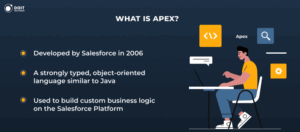
Unlike general-purpose languages, Apex runs exclusively on Salesforce servers and follows strict governor limits.
The Salesforce developer writes Apex code to implement sophisticated automation and integration logic. They structure this code using object-oriented principles while respecting Salesforce’s unique security model.
A skilled Salesforce developer applies several key Apex patterns:
Beyond basic syntax, a competent Salesforce developer knows how to write bulk-safe operations that process multiple records. They apply exception handling with try-catch blocks and understand how to manage database transactions.
Another critical skill for any Salesforce developer is mastery of Lightning Web Components (LWC). This modern framework has practically replaced the older Aura components and brings standard web technologies (e.g., JavaScript, HTML, and CSS) to platform development.
To build effective Lightning Web Components, a Salesforce developer typically follows these steps:
Additionally, a skilled Salesforce developer can use Lightning Data Service to minimize server calls and improve performance.
Now, let’s take a closer look at declarative automation skills for Salesforce developer roles.
The most important thing to know in 2026 is that Flow Builder has become Salesforce’s primary automation tool, replacing legacy Workflow Rules and Process Builder, which reached end of support on December 31, 2025.
Therefore, look for Salesforce developers who are already actively using Flow Builder in commercial projects.
A skilled Salesforce developer works with various Flow types depending on automation requirements:
Also, your ideal candidate should be able to debug and optimize flow performance. Usually, they use the Flow debugger to trace execution paths and identify bottlenecks, especially in flows that call multiple sub-flows or Apex actions.
Once the automation foundation is in place, it’s time to focus on data retrieval capabilities. Salesforce developer technical skills must contain proficiency in:
SOQL forms the foundation of all data operations in Salesforce, while SOSL enables full-text searches across objects.
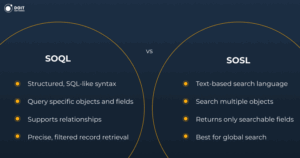
A proficient Salesforce developer writes efficient queries that respect governor limits. They understand parent-child relationships and can construct complex queries that traverse multiple objects in a single statement. For instance, they know how to query an Account with all related Contacts and their associated Cases without hitting query limits.
Now, let’s take a closer look at Salesforce developer skills for structuring business data. Unlike traditional databases, Salesforce uses a metadata-driven architecture where schema changes happen through configuration rather than SQL scripts.
A competent Salesforce developer designs scalable data models using both standard and custom objects and relationships that accurately reflect business processes.
The developer creates custom objects when standard Salesforce entities don’t meet specific requirements. They define field types, validation rules, and dependencies that enforce data quality at the platform level.
Beyond basic schema design, they configure record types and field-level security to control data access. A skilled Salesforce developer also plans for large data volumes by implementing custom archiving strategies.
When evaluating these Salesforce skills, you can present a business scenario and ask how they’d structure the data model. Experienced Salesforce developers will ask about integration needs and future scalability before proposing a solution.
Modern Salesforce deployments rarely operate in isolation. Your developer must handle various integration patterns, from real-time API calls to batch data synchronization.
In production, they use Apex callouts to consume external REST and SOAP services. They implement proper authentication using Named Credentials rather than hard-coding endpoints and credentials. They also understand how to expose Salesforce data through custom REST resources when external systems need access. For heavier enterprise integrations, many teams also bring in MuleSoft, Salesforce’s own integration platform, to manage complex data pipelines.
The Salesforce developer skills list in integration should include these capabilities:
During interviews, ask about their experience with specific integration tools and how they handle authentication in production environments. For example, you can look for Salesforce developers who mention monitoring and alerting strategies for integration endpoints.
Now, let’s shift focus to quality assurance through testing.
Generally, Salesforce requires 75% code coverage for Apex in production deployments. But coverage alone doesn’t always guarantee quality. Your Salesforce developer should write meaningful tests that validate business logic rather than just hitting coverage numbers.
Salesforce developer qualifications should include various testing approaches:
Also, there are some more Salesforce developer skills in testing that can set candidates apart.
For example, an experienced coder creates test classes with proper setup and teardown methods using @isTest annotations. They use Test.startTest() and Test.stopTest() blocks to reset governor limits during test execution. And, for integration testing, they implement HttpCalloutMock interfaces to simulate responses from external APIs.
Now, let’s focus on Salesforce skills list in modern development workflows. Salesforce DX revolutionized how teams build and deploy applications by introducing source-driven development and scratch orgs.
A skilled Salesforce developer uses the CLI for daily tasks rather than clicking through the UI. They organize metadata in modular packages and maintain clean version control practices. They spin up scratch orgs for feature development and use source tracking to sync changes efficiently.
Key Salesforce DX competencies include:
Also, look for Salesforce developers who mention experience with CI/CD pipelines using GitHub Actions, Jenkins, or Bitbucket.
Now, let’s look at the built-in AI part of Salesforce developer skills.
Salesforce introduced Einstein AI at Dreamforce 2016 as its artificial intelligence layer, built directly into the platform. It started as predictive analytics for sales and service, and it still powers the predictions and insights that surface across Salesforce clouds.
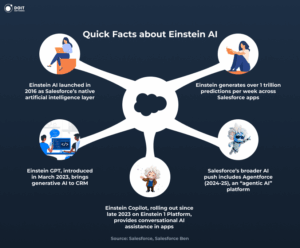
As Salesforce keeps investing in AI, Einstein skills are increasingly valuable for Salesforce developers in 2026. For a hiring conversation, look for comfort with the no-code and low-code predictive tools:
The generative side of Salesforce AI now runs through Prompt Builder and Agentforce, which is the next skill to evaluate.
Agentforce is Salesforce’s platform for building AI agents: assistants that read your CRM data and take action inside Salesforce. For example, they can answer a customer question or update a record on their own. In 2026, Agentforce is one of the most in-demand Salesforce developer skills. Developers who learned it early are getting hired fast, while hands-on experience is still hard to find.
Building an agent is a real development job, and it rewards a clear set of skills. A strong Salesforce developer starts by designing what the agent should do: the topics it handles and what a good outcome looks like for each one. From there, the work moves close to the code.
A capable Salesforce agent developer connects several parts of the platform:
Because the field is new, a certificate alone tells you little. Plenty of developers can describe an agent; far fewer have shipped one. If a role leans on prompt engineering or predictive or generative AI, check for real agent projects and ask how the developer grounded the data and handled errors.
Salesforce developer skills in 2026 bring together both platform-specific expertise and broader integration capabilities. From Apex programming to AI implementation, each skill contributes to building solutions that scale with your business requirements.
Finding Salesforce developers with this comprehensive skill set requires a careful evaluation of both technical depth and practical experience. Many hiring teams struggle with this assessment process, resulting in misaligned expectations.
DOIT bridges the evaluation gap by connecting companies with vetted Salesforce programmers who have undergone a comprehensive set of technical checks. If you need to hire skilled Salesforce developers, share your requirements with DOIT and get the first qualified CVs within 5 business days.
Share your requirements and receive the first relevant CVs within days.
Request CVsA Salesforce developer customizes and extends the Salesforce platform by writing Apex code, building Lightning components, creating automated workflows, and integrating external systems. They transform standard Salesforce functionality into customized solutions that align with specific business processes.
A Salesforce developer is a technical role that requires programming skills in Apex and JavaScript, database knowledge for SOQL queries, and an understanding of web technologies. While Salesforce offers declarative tools, the role demands strong technical competencies comparable to those in traditional software development positions.
Yes, Salesforce developer coding skills should include Apex, JavaScript for Lightning Web Components, and SQL-like query languages (SOQL/SOSL). While administrators can configure many features without code, developers must write custom code for complex integrations and advanced user interfaces.
Salesforce developers use SOQL (Salesforce Object Query Language) instead of traditional SQL, though the concepts are similar. SOQL is specifically designed for Salesforce’s data model and includes features like relationship queries and governor limits that don’t exist in standard SQL databases. Experience with SQL provides a helpful foundation, but a skilled Salesforce developer should be proficient in SOQL/SOSL.