Coming up with a great app idea is just half the battle. Your next challenge is to find a great development team that can bring any app idea to life. Hiring a full-stack developer is often the fastest way there: one person who can handle the front end, the back-end logic, the database, and the APIs that connect them. The question is: how to hire a full stack developer who can actually deliver in 2026, and where to find them?
According to Statista, the number of developers hit 28.7 million in 2024. It’s estimated that their population will increase to 45 million by 2030. And nowadays, you can find and hire full stack developers in any part of the world. It may even seem that there are too many developers, but the demand suggests otherwise. Businesses need more hands to build their next big things!
The U.S. Bureau of Labor Statistics projects 15% growth in software developer roles between 2024 and 2034, well above the average across all U.S. occupations, which means competition for strong full-stack engineers will not get any easier. And that is why we’ve prepared this article. Continue reading to find out how to hire a full stack developer for your project who can deliver the best services ever.

The term “Full Stack developer” usually means a tech specialist who understands both frontend and backend technologies, in other words, a full set of technologies needed to create an app.
The term “frontend” (also called the client-side) is used to describe what happens in the browser. The frontend is everything that the end-user sees and directly interacts with, such as a sign-up page or the site of an online store. The term “backend”, on the other hand, usually means the main logic (of the product) +API+database. So, the main logic of the product is working with the database and API for transferring data from and to the frontend.
In day-to-day work, a full-stack developer builds and maintains the user interface, writes the back-end logic and the API endpoints that the front end calls, sets up and queries databases, and deploys and maintains the result. A single hire covers the path from what the user clicks to what gets stored in the database.
Which is better: one full-stack developer or a pair of front-end and back-end developers? The right choice depends on where the product is and how the team is structured. A full-stack developer is usually the better fit for a lean team building an MVP or a small product on a tight roadmap. One person owning the full stack ships faster than two people coordinating across a handoff. The handoffs themselves create overhead: planning meetings, integration discussions, debugging arguments, and the cost of context-switching between the two halves of the stack.
Two specialists become the better choice further down the line. As the product scales, the front-end gets more demanding (complex UI, accessibility, animation, large-scale state management) or the back-end gets more demanding (data pipelines, performance tuning, distributed systems, security review). At that point, depth matters more than breadth, and trying to keep one person fluent in everything stops being realistic.
Strong full-stack developers cover a familiar set of skills across five areas: front-end foundations, back-end and APIs, databases, version control and basic DevOps, and a working set of soft skills.
As you know, full stack engineers can build both parts of the app, so they must have skills related to the backend. So it’s a mandatory for him to know at least one programming language for backend development, such as:
HTML and CSS are essential markup languages when it comes to the frontend. They help to determine the way a website can look and feel for prospective customers. HTML is used for adding new content to a web page and defining its structure with markup. CSS is a personalization tool used for the effective presentation of HTML elements on the web page.
Thus, full stack developers need to be proficient in CSS and HTML to create a highly intuitive frontend for websites or apps.
There is no single answer to what programming languages a full stack developer should know. It really varies. But many tech specialists see JavaScript is a necessary skill for full stack programmers. It’s an object-oriented programming language used for adding behaviors via HTML. JavaScript remains one of the most widely-used languages for both writing frontend and backend code.
Software development will be easier for full stack engineers if they have an in-depth knowledge of Angular, Vue or React. Developers should also keep their finger on the pulse of the fast changing industry as new frameworks, libraries, and tools are emerging all the time. Apart from that, full stack web developers need to know how and when to use DOM (Document Object Model), JSON (Open Standard File Format and Data Interchange Format).
There aren’t any developers left who haven’t used or heard about Git and GitHub. Git is the most popular Version Control System in the world. It allows programmers to keep track of all changes made to the app and streamline the work within the development team.
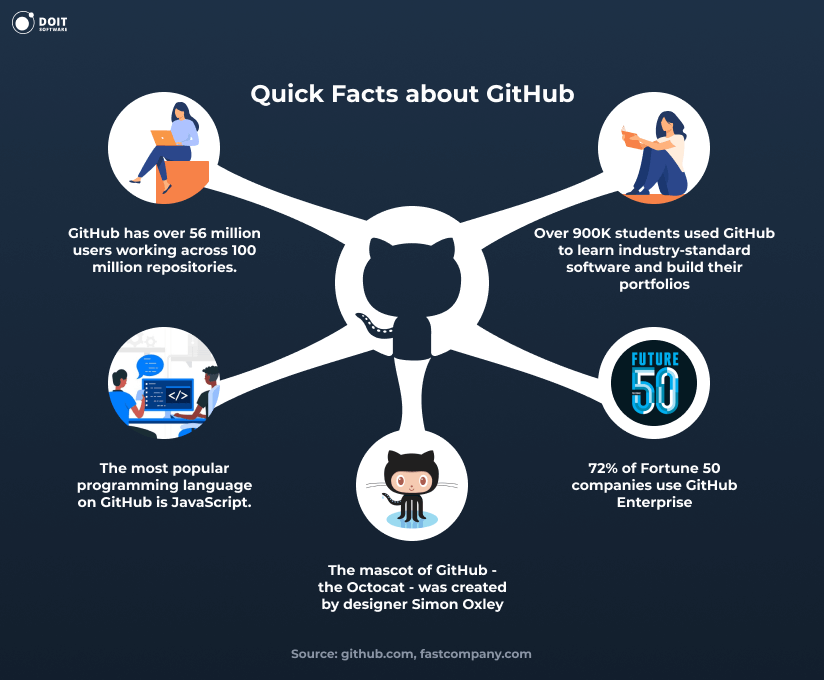
GitHub is known as a Git repository hosting service, but it also provides various powerful services to meet your development project needs. It’s a perfect fit for both small and large projects as it ensures efficiency and speed. It also includes collaboration features, such as wikis and task management tools. Programmers can easily manage projects, add changes to apps, websites, codes, and documents in a few clicks. Full stack developers need to know basic commands and examples to get the most out of GitHub features.
AI-assisted coding tools like Copilot and Cursor are part of the modern full-stack workflow. The hiring signal is in how the candidate uses them, especially whether they verify the AI’s output and catch errors before the code ships.
Packed with frontend and backend development skills, full stack coders become so-called warriors of software development. Knowledge of web architecture is also essential for full stack programming.
The primary responsibility of full stack developers is to deliver complex software applications starting from square one. Coders need to know how to structure the code and files, categorize data in the cloud and perform all the necessary programming tasks.
HTTP and REST are vital for software development, so full stack engineers need to know them both. HTTP is a protocol used to facilitate communication with clients. REST is an interface between systems that uses the HTTP protocol to collect data and process it. In other words, REST connects the frontend and the backend of the application.
Applications cannot function without a database where all the data is stored. That’s why full stack developers need to have basic knowledge of how to design, understand, and manage database queries. It would be also beneficial for software engineers to know how to work with JSON and XML.
As you already know, full stack developers deal with frontend and backend, but they must know basic UX/ UI design principles as well. The knowledge of design is also on the list of full stack developer skills, especially for creating user-friendly websites and apps. No one can argue that only attractive and neat software products can win the hearts of customers.
While hiring full stack developers, you need to pay attention not only to their professional skills, but also to their personal traits. The best full stack programmers possess the right balance of technical knowledge and soft skills. Here are some of the features they should have:
All in all, A full stack coder should be familiar with different programming languages and frameworks. They can tackle a wide range of tasks, including databases, development of user-friendly websites, and even some challenges related to UX/ UI design and QA sessions, etc.
Also, full stack developers are engineers who are equally proficient in solving frontend and backend issues. In most cases, they are experienced backend developers in their past, who decided to extend their skillset. Such programmers are familiar with a large amount of technologies, so they can create a software solution for any domain. The best full stack developers know how each layer works and how to connect them.
Thus, full stack developers participate in almost every stage of the software development cycle, including design, web development, testing, and even fixing bugs. They deal with significant development issues that require preliminary data analysis.

Before hiring full stack developers for your software project, you need to understand that they use different tech stacks for their work. And here are some basic types to differentiate:
MEAN stands for a mix of particular technologies, including Angular, Express, MongoDB, and Node JS. Developers use MEAN to build JavaScript-based applications, where one language covers both the server side and the user interface.

MEAN has two valuable advantages. It’s scalable and uses JavaScript for both the backend and frontend. Thus, when hiring а MEAN full stack developer, you need to check his or her JS knowledge.
Also, there is the MERN stack, which is actually a variation of the MEAN stack. What this means is that MongoDB, Express, and Node are present in this stack as well, but Angular.js is replaced with React.js. So in the MERN stack:
The high-performance and customized technologies used in this stack help programmers develop high quality web apps very quickly. MERN has become the default choice for many new product teams thanks to React’s market position.
Another variation is called MEVN, where instead of Angular.js or React.js we use VueJS. So in this case:
VueJS is very popular among programmers as it combines the best components from both Angular and ReactJS worlds, and can work really well for most development projects.
LAMP stack uses a different pack of technologies for software development. What does LAMP actually mean?
It’s second-to-none when it comes to the development and implementation of web-based applications and servers. LAMP has been used for years to develop enterprise-level web apps demanding greater customization and flexibility.
There is also RoR Stack, where RoR stands for Ruby on Rails. This framework, which most developers just call Rails, uses Ruby as a programming language and a database called SQLite with different compatible web servers. Rails is very popular among startup companies because it allows them to build apps fast and grow their business rapidly.
When hiring full-stack developers, you need to understand the differences between the major stacks of technologies used for software development. The choice of which technologies to use for your app depends heavily on the specific needs and requirements of your business.
The software industry is having an enormous impact on the world we live in, and extremely influential in the direction of our future. It’s also created a hotbed for entrepreneurial opportunities that anyone and everyone can leverage and get the most possible benefit out of the market.
But here is the thing. Many people with brilliant software ideas don’t have any coding experience and cannot bring those ideas to life. So we decided to create a short checklist to help everyone find the right tech guys for your project. Here’re the top four ways on how to find and hire full stack developers for your project.
Just start with your network. Ask your friends for recommendations, and be sure that someone you know should know where to find and hire a full stack developer with LAMP or MEAN, or other stack knowledge. Moreover, you can leverage LinkedIn and browse your friends’ profiles – someone may be a full stack developer ready to build your app from scratch.
Take advantage of Facebook and X by asking people for recommendations of full stack engineers that are interested in a new project. Of course, a tweet doesn’t sound like a great hiring strategy, but in some cases it may work really well.
Before rushing to look at freelancing platforms, you need to define the budget of your software project. Then, you’ll be able to filter candidates, considering a full stack developers’ salary expectations. Full stack developers’ freelance hourly rate can help you save a lion’s share of your budget when compared with hiring in-house full stack developers.
There are dozens of outsourcing software development companies all over the world. The code to successful cooperation consists of three essential things: the expertise, the location, and the budget. Luckily, DOIT Software meets all these requirements! And our top-notch software engineers are ready to rock the world without draining your budget.
We know for sure that hiring full stack developers is a quite difficult task, but we will help you find the right ones fast and stress-free. Contact us and get the first CVs in a few days.
What is a full stack developer? How to hire full stack developers? These questions have been already answered. But the challenge of hiring full stack developers is also about the choice of cooperation model. Some of them will be described in the section below.
Hiring freelancers has bespoke benefits such as flexibility and lower hourly rates when compared to the rates of in-house engineers and software development agencies. Since freelancers charge per hour, there is no fixed freelance full stack developer salary, and you can save a pretty penny. But it also has a wide range of drawbacks to consider, such as poor data confidentiality, less control over the working process, language barriers, and different time zones.
Easy to find
Security issues
Flexible
Less control
Low hourly rates
Hard to manage and evaluate
Language barriers
When it comes to hiring full stack developers, IT staff augmentation can also be considered. It’s a flexible model that allows for you scaling your team quickly, as well as eliminating administrative and legal hassles.
Feel like it’s right up your alley? Check out our article for more information on staff augmentation for software development projects.
A wider talent pool
Need to have a PM
Quick hiring process
Prepare a scope of work for a month
No extra expenses
Hiring full stack developers for your in-house team is the most expensive option. You need to take care of everything, starting from searching for prospects to organizing the workstation with all the required software for your new employees. But along with the disadvantages, hiring in-house staff has its own pros such as streamlined communication, advanced security, face-to-face brainstorming, etc.
Fast communication
Takes more time to find and hire
Deep dive into the product
Involves extra expenses
Full-time salary, full social package and other overhead.
Hiring full stack developers has become increasingly challenging in today’s competitive job market. Here are five significant obstacles in the process of finding and hiring top-notch full stack engineers:
To overcome these challenges, it’s essential to have a well-defined hiring strategy, use multiple staffing channels, offer competitive compensation, and conduct thorough technical interviews and assessments to evaluate candidates’ skills and expertise. Additionally, fostering a strong company culture that appeals to engineers can help in attracting and retaining top talent in this highly competitive field. Otherwise, consider using offshore or nearshore full stack development services.
Hiring full stack developers with DOIT Software isn’t only easier and faster than with other firms, but also more reliable. We know where to find and hire full stack developers. Just give us ten days and we’ll schedule as many interviews as possible. You need only choose what developers you’d like to work with, and we’ll take care of everything else.
Bespoke benefits to augment your team with full stack engineers with the help of DOIT Software:

Access to our unlimited talent pool

Unmatched flexibility of the recruitment process

Accelerated business growth

Full control over the development process

No extra costs for infrastructure

More time to focus on your core business needs
Ready to rock the world with your software solution? Request the specialists, and we’ll handle sourcing, vetting, contracts, and onboarding for you.
There you have it! We hope you discovered what full stack developers are and how to hire a full stack developer for your software development project in 2026. It’s now time to choose what model of cooperation best fits your business needs and budget, and take it from there.
If you want to find out more about staffing or hiring full stack developers, just contact us for more information. Let’s build a top-notch software solution to back up your business together!
The full stack developer is a software engineer who can work on both the frontend and the backend side of the application. A full stack developer often takes part in every stage of the app development process. A full stack coder can start with building up the backend part of the app and then switch to its frontend part.
It depends on the channel. A vetted staff augmentation partner or pre-vetted freelance platform can deliver first candidate profiles in 3-5 business days, with a hire usually completing in 1-3 weeks. Direct sourcing through job boards and recruiters typically takes 4-8 weeks. Senior in-house hires in tight US markets often take 8-12 weeks or longer, especially when the chosen candidate has notice to serve on a current role.
Java, C#, Python, PHP, JavaScript are the primary programming languages required for full stack development. To become a full stack developer, a coder has to be proficient in multiple programming languages, frameworks, tools, and technologies.
A US full-stack developer earns an average of $118,825 per year in 2026 according to Glassdoor. Staffing companies often charge per hour. The hourly rate of a full stack developer at DOIT Software ranges between $35 – $58.